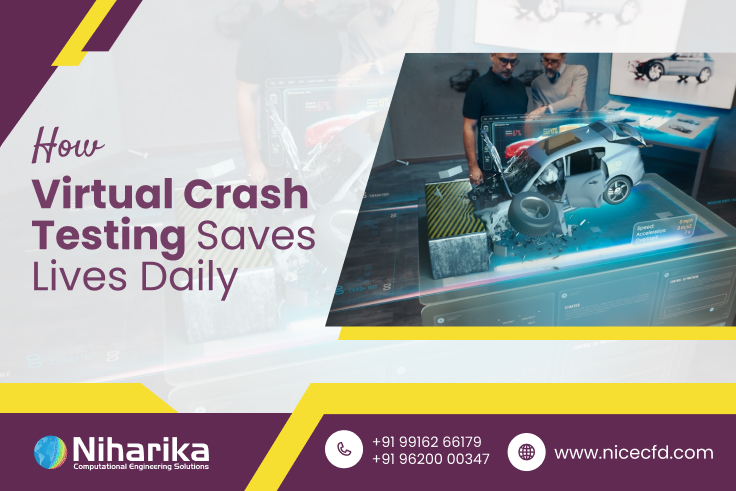
Every time a car rolls out of a showroom, it carries an expectation—protecting the people inside it. Road accidents remain a major concern across the world, and automotive engineers work constantly to improve safety systems. Crash testing is a crucial part of this effort, helping engineers understand how vehicles behave under extreme conditions.
Physical crash tests, though reliable, demand heavy budgets, long preparation time, and a large number of prototypes. Each crash destroys a costly test vehicle. And even then, engineers can only study a handful of scenarios due to time and cost limitations.
This is where virtual crash simulations powered by the Finite Element Method step in. FEM allows engineers to study complex crash events inside a computer, long before a physical test is needed. It brings clarity, speed, and precision to a field where every detail matters, making it essential for modern automotive engineers and for learners enrolling in FEM analysis courses.
What is FEM in Crash Testing?
Crash testing with FEM helps engineers understand how a vehicle responds to forces during an impact. Instead of relying only on physical tests, FEM brings up a virtual environment where damage, deformation, and safety can be studied in detail. This method offers insights that guide every stage of vehicle design.
The Finite Element Method is a numerical technique used to break complex structures into smaller, manageable components. These smaller parts, known as elements, help engineers calculate how the entire structure responds to loads, impacts, and stresses. FEM is widely taught in every advanced finite element method course because of its role in engineering design and simulation.
• How FEM breaks down vehicle structures into thousands of elements
A vehicle is divided into thousands—or even millions—of tiny elements, each representing a small region of their body. These elements collectively capture the behaviour of the full structure. When an impact occurs, each element shows how much stress it carries and how much it deforms.
• Simulation of crash scenarios
Using FEM, engineers simulate various crash events. These include frontal collisions, side impacts, rollovers, rear-end crashes, and even pedestrian impacts. FEM helps map the exact path of forces through their frame, panels, and safety systems.
• Key parameters analyzed
During simulations, engineers examine whether parts deform in a controlled way, how energy is absorbed, how the cabin remains intact, and whether the safety components respond effectively. Tracking stress, strain, and deformation guides decisions that directly influence passenger protection.
Understanding how CAE improves fluid flow simulations and design processes
How Virtual Crash Simulations Work
FEM crash testing is a step-by-step process, starting from building the digital model to running the final simulation. Every part of the vehicle must behave as it would in real life. The accuracy of each step determines the reliability of the results.
• Creating digital vehicle models with accurate material properties
Engineers begin by building a digital version of the car. This model includes the chassis, body panels, interior structure, and safety components. Material properties play a major role—steel, aluminium, polymers, and composites must behave exactly as they would during real crashes.
• Setting up crash scenarios and impact conditions
Once the model is ready, engineers define the impact conditions. This includes the speed of the vehicle, direction of impact, barrier type, and occupant position. Boundary conditions replicate real testing grounds.
• Running simulations using FEM software (Ansys, LS-DYNA)
Software such as LS-DYNA and Ansys performs the simulation. These tools help predict how each part of the car absorbs energy and how the structure behaves milliseconds after impact. Students trained in FEM analysis courses quickly recognise the importance of accurate inputs in these simulations.
• Analyzing results
Simulation outputs allow engineers to assess crumple zones, evaluate cabin integrity, study airbag deployment timing, and check whether seatbelts restrain occupants effectively. These findings guide the next design iteration.
Real-World Benefits
FEM-powered crash simulations bring practical benefits that go far beyond convenient testing. They save money, cut development time, improve designs, and make vehicles safer for everyone. These advantages explain why the industry relies heavily on virtual testing.
• Cost Savings
Manufacturers can cut down the number of physical prototypes required. Virtual tests provide early insights, which means fewer expensive builds and fewer destructive tests.
• Time Efficiency
Engineers can study dozens of crash scenarios within a matter of days. This is a major improvement over physical testing, where each test demands weeks of preparation.
• Design Optimization
Design changes can be tested quickly. Engineers modify geometry, materials, or safety components and rerun simulations without waiting months for new prototypes.
• Enhanced Safety
Some crash situations are too risky or too complicated to recreate in a lab. FEM simulations help examine these scenarios safely.
• Regulatory Compliance
Automakers must meet strict global safety standards. FEM helps predict whether a design will pass certification, reducing risk in the approval process.
The benefits of signing up for online CFD courses.
Impact on Lives
The real value of FEM lies in its impact on people. Better crash predictions lead to safer designs. Safer designs help protect families, drivers, and pedestrians on the road.
• Statistics on improved vehicle safety ratings
Vehicles that rely on simulation-driven development often score higher in safety ratings because engineers can refine every detail before physical testing.
• How simulation-driven designs reduce injuries and fatalities
Engineers identify weaknesses early and correct them, resulting in stronger cabins and better protective systems. This directly reduces injuries and fatalities in real-world crashes.
Simulations help develop stronger passenger compartments, more effective crumple zones, smarter airbag systems, and improved seatbelt mechanisms.
The Future of Crash Testing
FEM continues to evolve. With advancements in computing, simulations are becoming more accurate. The future holds faster results and smarter models.
• Integration with AI and machine learning: AI can predict crash patterns and suggest design improvements based on past simulation data.
• Real-time simulation and autonomous vehicle safety: Future vehicles, especially autonomous ones, will rely on real-time simulation models to assess risks instantly.
• Continued evolution of FEM technology: FEM software will continue refining models, material behaviour, and accuracy, making virtual testing even more reliable.
FEM-based crash simulations bring clarity, speed, and accuracy to automotive safety. They help engineers study complex crash events, improve structural design, cut costs, and protect lives. With growing computing power, their impact continues to expand.
Today, FEM is no longer optional—it is essential for designing safe vehicles. Virtual testing leads to stronger structures, smarter safety systems, and better outcomes in real crashes.
To work in this field, professionals and students should strengthen their skills through FEM analysis courses or a detailed finite element method course at NICECFD. It is the first step toward contributing to safer roads and better engineering.