
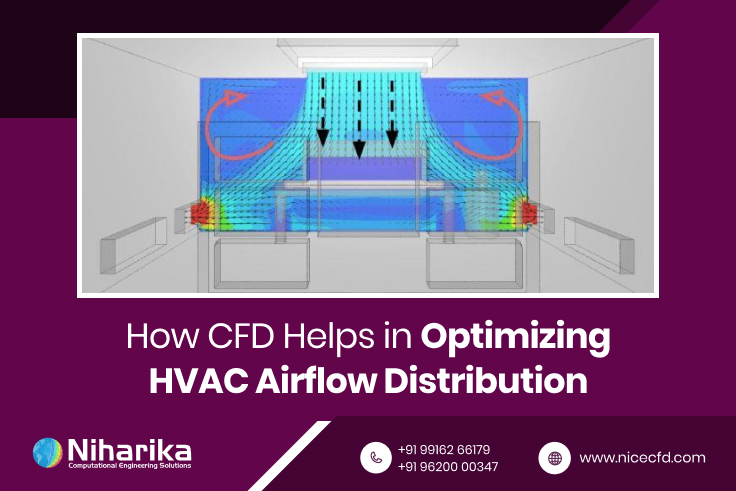
Modern buildings demand more than basic heating and cooling. They need healthy air, stable comfort, and responsible energy use. HVAC systems carry this load, but designing them well requires clarity on how air actually moves indoors. This is where Computational Fluid Dynamics (CFD) steps in. Many engineers today choose to learn CFD and FEA analysis because the industry expects accuracy, not guesswork, in ventilation planning.
CFD is a simulation method that predicts how air flows, mixes, cools, or heats inside a space. It uses physics and numerical models to convert complex indoor behavior into clear, visual results.
HVAC performance depends on flow patterns that are difficult to judge with simple calculations alone. CFD gives designers the confidence to test ideas before they become expensive installations.
Buildings today must protect occupant health and also reduce energy waste. Achieving both requires careful planning. CFD helps designers strike this balance by revealing how ventilation, temperature, and contaminants behave together.
Key CFD Applications in HVAC
HVAC engineers use CFD to answer questions that are hard to evaluate on-site. It shows where air moves freely and where it stagnates. It also predicts comfort, cleanliness, and cooling efficiency in one sweep.
• Identifying dead zones and uncomfortable areas
CFD quickly highlights areas with slow-moving air or excessive draft. These “dead zones” often cause stuffiness or uneven temperatures. By adjusting diffuser placement and flow rates in the model, designers can fix issues before construction.
• Predicting temperature stratification and PMV/PPD indices
Comfort relies not just on thermostat settings but on how heat distributes across a room. CFD maps stratification and uses PMV/PPD indices to show how occupants will feel. This helps designers ensure consistent comfort even in tall spaces or rooms with large windows.
• Modeling pollutant spread and ventilation effectiveness
Indoor contaminants—from CO₂ to aerosols—spread in patterns that are not always intuitive. CFD reveals these paths clearly. This insight supports healthier ventilation layouts, especially in hospitals, labs, classrooms, and kitchens.
• Reducing HVAC loads while maintaining comfort
Energy use increases when systems work harder to compensate for design oversights. CFD allows engineers to evaluate diffuser angles, duct sizing, insulation, and return-air placement. This eliminates unnecessary loads and encourages efficient operation. Many engineers pursuing ANSYS CFD courses learn these strategies as part of modern HVAC simulation practice.
Understanding the application of FEM in the biomedical industry.
Real-World Benefits
CFD values become clearer when applied to real buildings. It helps teams make decisions backed by physics. It reduces onsite rework and shortens approval cycles.
• Design validation before construction
Instead of waiting to test performance after installation, CFD validates designs at the drawing stage. This reduces the risk of mismatches between expected and actual HVAC behavior.
• Cost savings through optimized equipment sizing
Oversized equipment increases both CAPEX and OPEX. CFD enables accurate sizing by showing the actual load requirement. This leads to leaner designs without compromising comfort.
• Compliance with standards (ASHRAE, LEED)
Green building ratings and ventilation standards expect data-backed justification. CFD offers reliable documentation to meet ASHRAE airflow requirements and LEED criteria for air quality and energy use.
• Solving problematic spaces (conference rooms, atriums, clean rooms)
Some areas are naturally difficult due to high occupancy or large volume. CFD helps create ventilation strategies tailored for such spaces. It reveals issues that traditional estimates may overlook.
CFD vs Traditional Methods
Conventional design tools rely on simplified formulas. They work for typical layouts but fall short for complex interiors. CFD compensates for this gap with detailed predictions.
• Traditional: Rule-of-thumb, manual calculations, physical testing
Traditional design depends heavily on assumptions. Physical tests are limited, costly, and possible only after installation. This limits design flexibility.
• CFD: Virtual testing, unlimited scenarios, detailed visualization
CFD creates a “digital twin” of the space. Engineers can test multiple ideas, compare options, and make informed choices. Many professionals take ANSYS CFD courses or learn CFD and FEA analysis to build this skill.
When CFD is essential vs optional
CFD becomes essential for buildings with high occupancy, special ventilation needs, or tight energy goals. It is optional only when layouts are simple and comfort demands are low.
Implementation Process
Running a CFD simulation requires methodical inputs. Each step shapes the accuracy of results. When done well, it becomes a predictable part of the HVAC design workflow.
• Input requirements (geometry, boundary conditions, loads)
Engineers import building geometry from CAD or BIM models. They specify airflows, temperatures, occupancy, and heat sources.
• Simulation setup and mesh generation
A clean mesh ensures reliable results. Proper sizing near diffusers, walls, and breathing zones capture important details without unnecessary computation.
• Result analysis and design iteration
Once results are ready, engineers study contours, vectors, and comfort indices. They adjust design parameters, rerun simulations, and confirm improvements.
• Integration with BIM and design workflow
CFD integrates well with BIM platforms. This creates smoother coordination between architects, MEP teams, and sustainability consultants.
How FEM is contributing to the aerospace industry.
Case Study Example
Real projects show the true strength of CFD. Below is a simple case that illustrates how airflow studies support better decisions.
A mid-sized office in a metro city faced uneven temperatures and rising energy bills. CFD revealed poor diffuser placement and thermal pockets. After optimization, comfort improved and energy use dropped by nearly 18%.
The problem was uneven cooling. CFD analysis identified dead zones and strong drafts. The solution involved relocating diffusers and adjusting flow rates. The system then worked smoothly without additional equipment.
CFD helps HVAC designers understand airflow, comfort, and energy use with clarity. It shows how air behaves, where heat accumulates, and how contaminants spread. With this insight, engineers can create healthy and efficient buildings.
Modern buildings demand accuracy. CFD has become a standard tool rather than an optional step. By reducing rework, preventing oversizing, and improving comfort, CFD delivers strong returns on investment.
To design healthier and more efficient buildings, reach out to NiceCFD. Our team brings strong expertise to every HVAC CFD project, supported by professionals trained through ANSYS CFD courses and programs to learn CFD and FEA analysis.