
Blog

ANSYS fluent courses

How to Build a Competitive CFD Portfolio to Land Your Dream Engineering Job

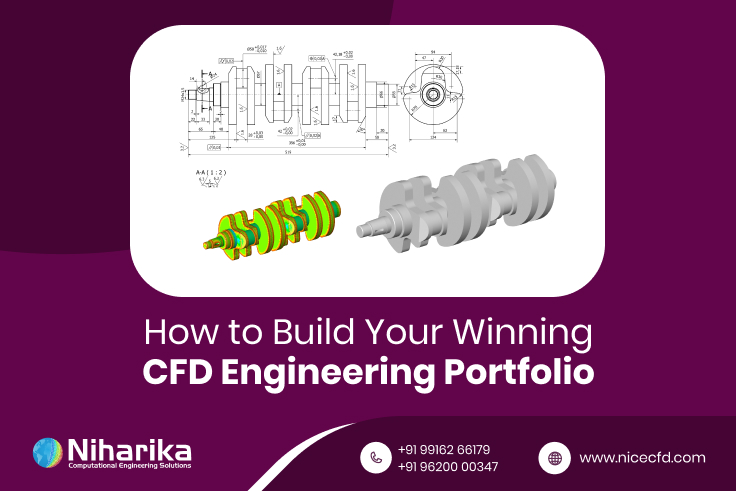
A strong CFD portfolio can set you apart in a crowded engineering job market. Recruiters want proof that you can handle real problems, not just theory. Your portfolio becomes your voice when you are not in the room, and it speaks through the clarity, structure, and depth of your work.

Companies rely on simulation now more than ever. Budgets and timelines are tight, so they want engineers who can run accurate simulations with confidence. A polished portfolio shows that you can approach a problem systematically and deliver reliable results.

They look for practical experience, not just academic exposure. They want to see how you think, how you troubleshoot, and how you interpret data. Clean workflows, thoughtful choices, and clear documentation help them understand your technical maturity.

Choose the Right Projects

A well-rounded CFD portfolio begins with the right project choices. Your aim is not to show everything you know, but to select work that proves you can solve industry-relevant problems with a structured approach.
Pick 3–5 diverse projects that showcase different skills
Select projects that reflect varied physics: external aerodynamics, internal flows, heat transfer, or multiphase problems. A balanced mix shows adaptability. If you learnt these through ANSYS fluent courses or other CAE courses, mention the skills—but keep the focus on the clarity of your work, not the tool you used.
Include at least one industry-relevant case
Choose a case linked to your target field. Aerodynamic drag reduction for automotive roles, combustor mixing for aerospace, or pump performance for energy companies—these help recruiters picture you working on their projects.
Balance between complexity and clarity
A project does not need to be “big” to be impressive. What matters is how clearly you present the physics and reasoning. Employers appreciate simple problems handled with precision more than complex ones filled with assumptions.
Benefits of signing up for online CFD courses

Essential Elements to Include

Every project must follow a clear structure. This helps reviewers understand the context, decisions, and outcomes without guessing.
Problem statement and objectives
Start with a crisp description. What is the engineering question? What do you want the simulation to reveal or validate?
Geometry and meshing approach
Explain your geometry preparation steps. Convey why you chose a specific mesh type and what refinements you applied. Mention whether your meshing experience comes from CAE courses or training modules.
Solver settings and boundary conditions
State your solver type, boundary conditions, turbulence model, material properties, and any assumptions. Hiring managers want to see you understand the physics behind each setting.
Validation and verification
Describe how you checked that your simulation is on the right path. Show comparisons with published data, grid studies, or analytical estimates.
Results with proper post-processing
Use contours, streamlines, and plots to present results. Ensure they are clean, readable, and placed with purpose. Explain what each result means in plain language.
Key findings and conclusions
Wrap up with what you learned, what worked well, and what could be improved. Employers appreciate reflective thinking.

Demonstrate Technical Skills

The tools you use matter, but the way you use them matters more. Your portfolio should prove that you can navigate the entire CFD workflow with awareness and discipline.
Show proficiency in CFD software
List the tools you have used—ANSYS Fluent, OpenFOAM, STAR-CCM+, or others. If you have completed ANSYS Fluent courses or CAE courses, highlight the practical skills gained from them.
Include mesh independence studies
A mesh independence test shows maturity. It proves that you understand numerical accuracy and do not rely on a single mesh.
Display understanding of turbulence models
Discuss why you chose a specific turbulence model. A brief explanation of RANS vs LES or the choice of k-omega SST goes a long way.
Prove validation against experiments
If you benchmark your results against experimental data, mention the source. Recruiters trust validated results far more than purely numerical predictions.
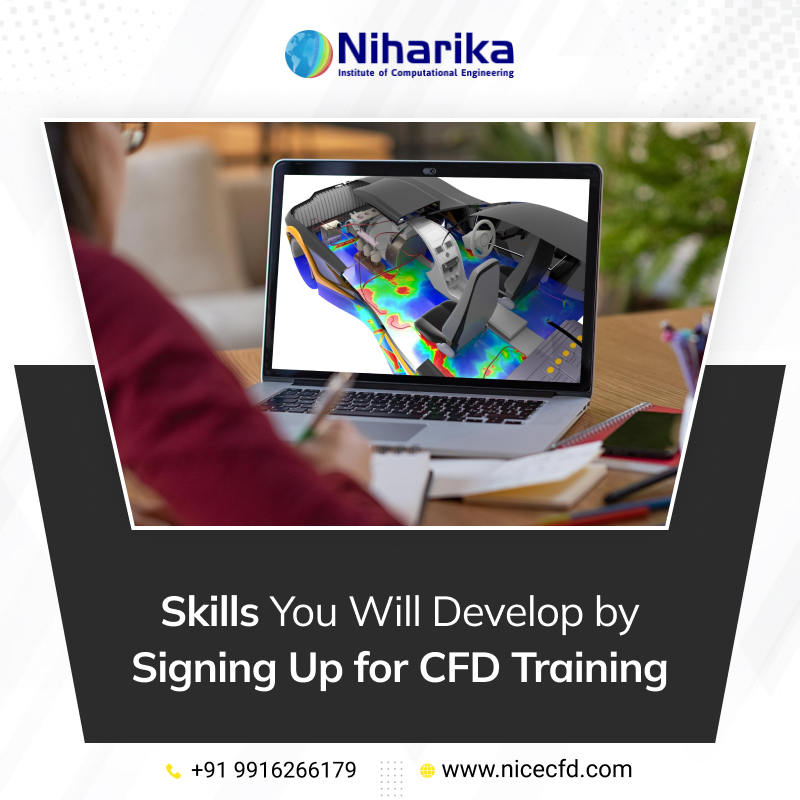
Core skills to develop by signing up for CFD training.

Present Your Work Professionally

Presentation is not decoration—it is communication. A recruiter should understand your work without extra explanation.
Use clear, high-quality visuals
Your contours, vectors, and graphs should have uniform scales and legible labels. Avoid clutter. Keep colors consistent across images.
Write concise technical descriptions
Short sentences work best. Avoid jargon unless necessary. Explain the “why” behind each step.
Create a clean, navigable portfolio website or PDF
Your portfolio should look organized. Use simple headings, steady spacing, and a neat layout. A single PDF or a basic website works well.
Include links to code repositories
If you use scripts for meshing, case setup, or post-processing, link them. This shows professionalism and transparency.

Add Real-World Context

CFD is not just about solving equations. It is about solving engineering problems.
Explain the engineering impact of your work
Connect your simulation to a practical outcome—less drag, lower pressure drop, improved mixing, or safer temperatures.
Highlight optimization or design improvements
Show how your simulation guided decisions. A small geometry tweak that improves performance can speak volumes.
Mention computational efficiency
Explain how you managed run times, hardware limits, and mesh sizes. Practical awareness is valued by employers.

Common Mistakes to Avoid

A strong portfolio is not just what you include but also what you avoid.
Showing only coursework without independent projects: Include at least one self-initiated project. Employers want to see curiosity.
Poor visualization and unclear results: Avoid blurry images, unlabelled axes, and random color scales.
Missing documentation of methodology: Do not skip steps. Missing details raise doubts about your workflow.
Overcomplicating simple problems: Focus on clarity. Show that you understand the physics instead of forcing complexity.


A strong CFD portfolio shows skill, clarity, and purpose. Select 3–5 solid projects, document your methods, and present them neatly. Update your portfolio often, customize it to your target industry, and stay consistent in your workflow.

Remember—quality outweighs quantity, and three excellent projects speak louder than ten average ones. ANSYS Fluent courses and CAE courses can help build skills, but how you present your work creates the real impact.

Best Online & Offline CFD Training at Bangalore, Niharika Institute of Computational Engineering, Industry Oriented course on CFD analysis, Advanced course on Automotive CFD analysis, Advanced course on Aerospace & Defence CFD analysis, Advanced course on CFD analysis for Semiconductor Industry, cfd training, online fluent course, online icem cfd course, online cfd courses, icemcfd meshing, Internship, cfd classes, cfd training, cfd course, cfd training courses, cfd course online, cfd training online, cfd learning, cfd online course, cfd analysis courses, cfd analysis course in india, cfd analysis courses in india, Advanced course on CFD analysis, Advanced courses on CFD analysis, professional courses on CFD analysis, courses on CFD analysis, Ansys cfd courses, cfd courses in india, online cfd courses, cfd online training courses, cfd training institutes in bangalore, cfd training in bangalore, ansys cfd training, cfd training online, cfd training academy, cfd online training courses, cfd courses in bangalore, ansys training, ansys online training, ansys cfd training, ansys training courses, ansys training online, ansys workbench training, ansys cfx training, hypermesh training centers in bangalore, hypermesh training, hypermesh course, fluid dynamics online course, fluid dynamics course online, openfoam online course, online fluid dynamics course, online ansys course, ansys online course, fea simulation, fem simulation, cae courses, CAE courses, Aerospace CFD, Industry Oriented course on Structural analysis, Industry Oriented course on FEM analysis, CFD Engineer Master Programme, CFD Training & Placements, Online CFD courses, Ansys CFD courses, Automotive CFD analysis, Aerospace CFD analysis, ls dyna courses, cae courses in Bangalore, cae courses in India, cfx courses, ansys cfx courses, ansys icepak training, cfd analysis consultants in Bangalore, cfd analysis companies in bangalore, karnataka, bangalore, india